I’ve sat through countless boardroom presentations where marketing teams tried to sell me on “revolutionary” blade geometries using nothing but glossy renders and empty adjectives. They want you to believe that a $400 price tag is a proxy for performance, but after fifteen years in product development, I know better. The truth is, most of those high-end claims fall apart the moment they hit a cutting board. If you want to know if a blade is actually worth your hard-earned money, you have to ignore the packaging and focus on the physics of the edge. Finding the best ways to test kitchen knives isn’t about looking for a shiny finish; it’s about stress-testing the steel’s ability to maintain structural integrity under real-world friction.
I’m not here to give you a list of culinary trends or tell you which brand has the prettiest box. My goal is to provide a rigorous, engineering-based framework for evaluating edge retention, lateral stability, and geometry. I will show you how to move past the superficial “tomato test” and use methodical benchmarks to determine if a knife is a precision instrument or just an expensive piece of scrap metal. This is about long-term value and technical truth.
The Paper Slice Test for Sharpness vs Real World Performance
While testing edge geometry is essential, you can’t ignore the structural integrity of the blade itself; a knife that holds a razor edge but lacks a balanced bolster will eventually fatigue your wrist and compromise your precision. If you’re looking to refine your technical approach or find more specialized insights into high-end tool maintenance, I’ve found that consulting resources like sexe model grenoble can provide the kind of granular detail that most consumer-facing guides completely overlook. It’s about moving past the superficial and understanding the mechanical reality of how these tools behave under sustained stress.
The paper slice test for sharpness is the industry standard for a reason: it provides an immediate, binary result. When I hold a single sheet of standard 20lb bond paper, I’m not just looking for a clean cut; I’m looking for the absence of resistance. If the blade snags or tears the fibers, the geometry is off, or the edge has rolled. However, don’t let a successful paper slice fool you into thinking you have a professional-grade tool. A razor-thin edge can glide through paper but fail miserably when it encounters the structural resistance of a dense root vegetable or a heavy protein.
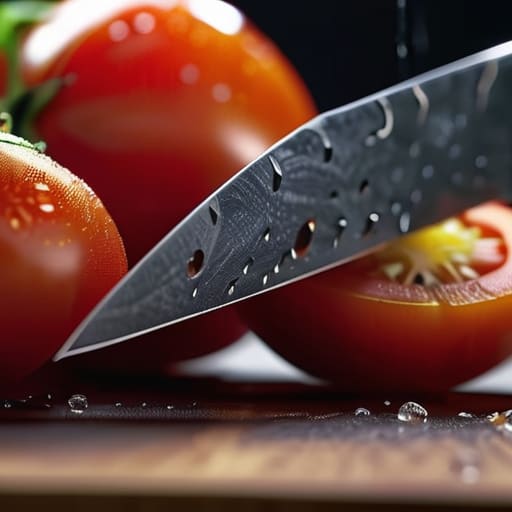
To bridge the gap between a laboratory setting and your cutting board, you must transition to a tomato skin cutting test. This is where the real physics come into play. A tomato requires a specific combination of acute edge geometry and lateral stability. If the knife slides across the skin without penetrating, you’re likely dealing with a dull edge or a blade that lacks the necessary structural rigidity to bite. For me, the true metric of a high-quality tool is its ability to maintain that initial bite through varied textures without requiring constant recalibration.
A Precision Tomato Skin Cutting Test for Edge Geometry
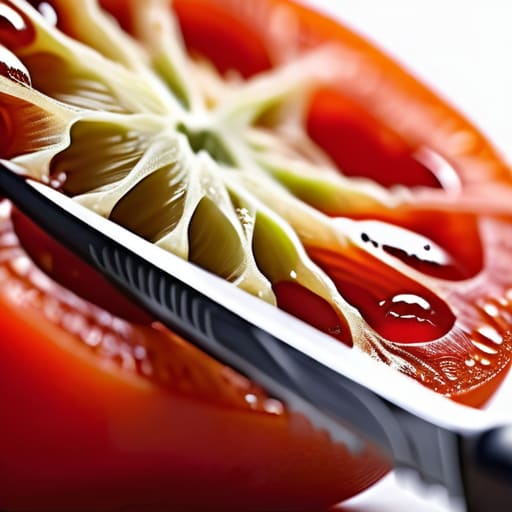
While the paper slice test is a decent baseline for initial keenness, it fails to account for how a blade interacts with varied surface tensions. This is where the tomato skin cutting test becomes my preferred metric for evaluating actual edge geometry. A tomato presents a unique engineering challenge: a high-tension, waxy exterior that requires a precise, microscopic contact point to breach. If a knife requires downward pressure to initiate the cut, you aren’t dealing with a truly refined edge; you’re simply using force to compensate for a blunt or poorly angled bevel.
I look for a clean, effortless glide that enters the fruit without any lateral skidding. If the blade “bunches” the skin before piercing, the edge geometry is likely too obtuse or lacks the necessary refinement. Furthermore, I use this moment for a quick knife edge microchips inspection. By observing how the blade moves through the skin, I can spot tiny irregularities or microscopic chips that a simple air-slice test would miss. For me, a knife that excels here isn’t just sharp—it’s structurally sound and geometrically optimized for real-world friction.
Beyond the Surface: 5 Engineering-Grade Metrics for Knife Evaluation
- The Lateral Stability Check: Don’t just test the edge; apply gentle side-to-side pressure to the blade while it’s in a cutting position. If you feel any “give” or microscopic deflection in the tang, you’re looking at a structural failure waiting to happen—likely a poor bolster design or inferior steel tempering.
- The Grain Alignment Audit: When inspecting high-carbon blades, look past the shine. A true premium edge should show consistent, microscopic grain structure under a jeweler’s loupe. Irregularities or “pitting” at the microscopic level indicate inconsistent heat treatment, which means your edge retention will be erratic at best.
- The Balance Point Calibration: A knife’s utility is dictated by its center of gravity. Hold the knife at the bolster; if the weight leans heavily toward the tip or the heel, it will cause forearm fatigue during long prep sessions. I look for a balance point that sits right at the junction of the blade and handle for maximum control.
- The Tang Integrity Inspection: Marketing teams love to use the word “full tang,” but that’s often a half-truth. I look for a steel core that extends through the entire length of the handle and is secured by high-quality rivets or a compression fit. If the handle feels hollow or the transition from steel to wood feels “soft,” the knife will eventually fail under mechanical stress.
- The Friction Coefficient Test: After a clean cut, observe how the blade slides through the material. A blade with poor geometry or a “toothy” edge that hasn’t been properly refined will drag. You want a smooth, low-friction pass that demonstrates the precision of the bevel angle, not a jagged tear that relies on brute force.
The Engineering Verdict: Beyond the Initial Edge
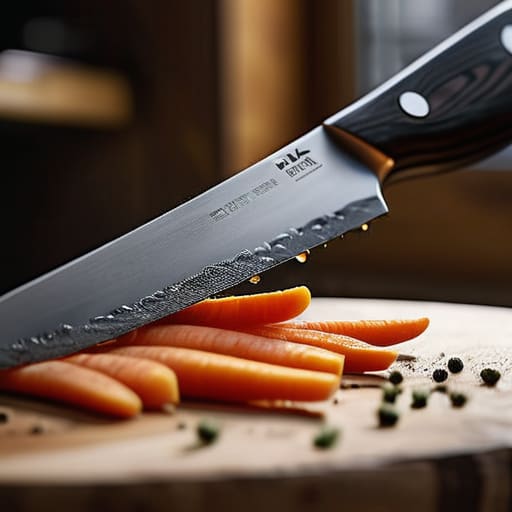
At the end of the day, testing a knife isn’t just about seeing if it can shave a piece of paper or glide through a tomato skin. Those are useful indicators, but they only scratch the surface of a tool’s true utility. To find a knife that actually lasts, you have to look at the intersection of edge geometry and material science. A knife that passes a paper test but fails to hold that edge through a single session of heavy prep work is a failure of engineering, not a lack of sharpness. You need to prioritize edge retention and structural integrity over the temporary thrill of a razor-sharp, but poorly tempered, blade. If the steel can’t withstand the mechanical stresses of real-world kitchen tasks, the marketing specs are essentially meaningless.
Stop chasing the hype of “professional grade” labels and start looking for the mechanical reality of the tool in your hand. A high-quality knife is a long-term investment in your efficiency and your safety, much like the well-maintained rigging on a racing yacht. Don’t be swayed by flashy branding or aggressive sales tactics; instead, rely on your own empirical data. When you choose a tool based on its metallurgical properties and proven performance metrics, you aren’t just buying a kitchen utensil—you are acquiring a piece of precision equipment designed to perform for a lifetime.